I had always been one of those eager students in women’s Bible study who flipped open a concordance after class to see the original words and how they were used in other verses. Unlike some, I enjoyed when preachers shared insights about Greek or Hebrew words. It seemed like they held the key to unlocking a deeper understanding of the passage. However, when it came to choosing a degree path in seminary, I ignored the degrees that required languages. I was only taking classes to get some additional training; I didn’t need an entire Master of Divinity to occasionally teach Sunday school, right? The languages seemed intimidating and unnecessary for me to study. However, after a few courses I started to prayerfully reconsider that decision. Even if I wasn’t going use the languages often, was there still value for the Church at large to grow in the number of women who have a working familiarity with them? This question led me to step out and change my degree to a slightly longer one that required a language series.
Before beginning those language classes, I was teaching a Sunday school class through the book of James. The participant workbooks I was utilizing included a copy of the CSB version of the text. Flipping through the first two chapters I was glad to see it utilized the gender inclusive translation “brothers and sisters” for the word Adelphoi (Ἀδελφοί). Unlike many languages, nouns do not have a grammatical gender in English. Spanish speakers don’t consider a bathroom particularly male, but el baño is a gendered word and takes the masculine article. Similarly in Greek, when addressing a mixed group of siblings, the word is masculine but not exclusively referring to men. Even in my complementarian setting we had been taught that when the ESV said “brothers” it referred to both men and women.
So, I was very curious when I noticed the CSB switched to the gender specific “brothers” only in James 3:1, “Not many should become teachers, my brothers because you know that we will receive a stricter judgment.” A small footnote explained it could be alternately translated, “or brothers and sisters.” Why did the CSB choose to exclude sisters in this instance? I looked up the Greek text expecting to see a different word or change in form, but it was the exact same way James used the word over 10 other times throughout the book. Nothing was different except it specifically addressed teachers. As the teacher of the class I knew James’s warning also applied to me, so I chose a different translation for the workbooks, one that reflected his underlying point more clearly in English.
Without any training in the Greek language, I appealed to my pastor who had studied the languages in seminary as to why it was translated differently. He mused the change probably had something to do with the fact the CSB was a translation project of a complementarian denomination. Confused, I protested aloud, “wait, isn’t the text supposed to inform our interpretations, not the other way around?” This cemented my conviction that more women needed to study the Biblical languages and strengthened my resolve to be among them.
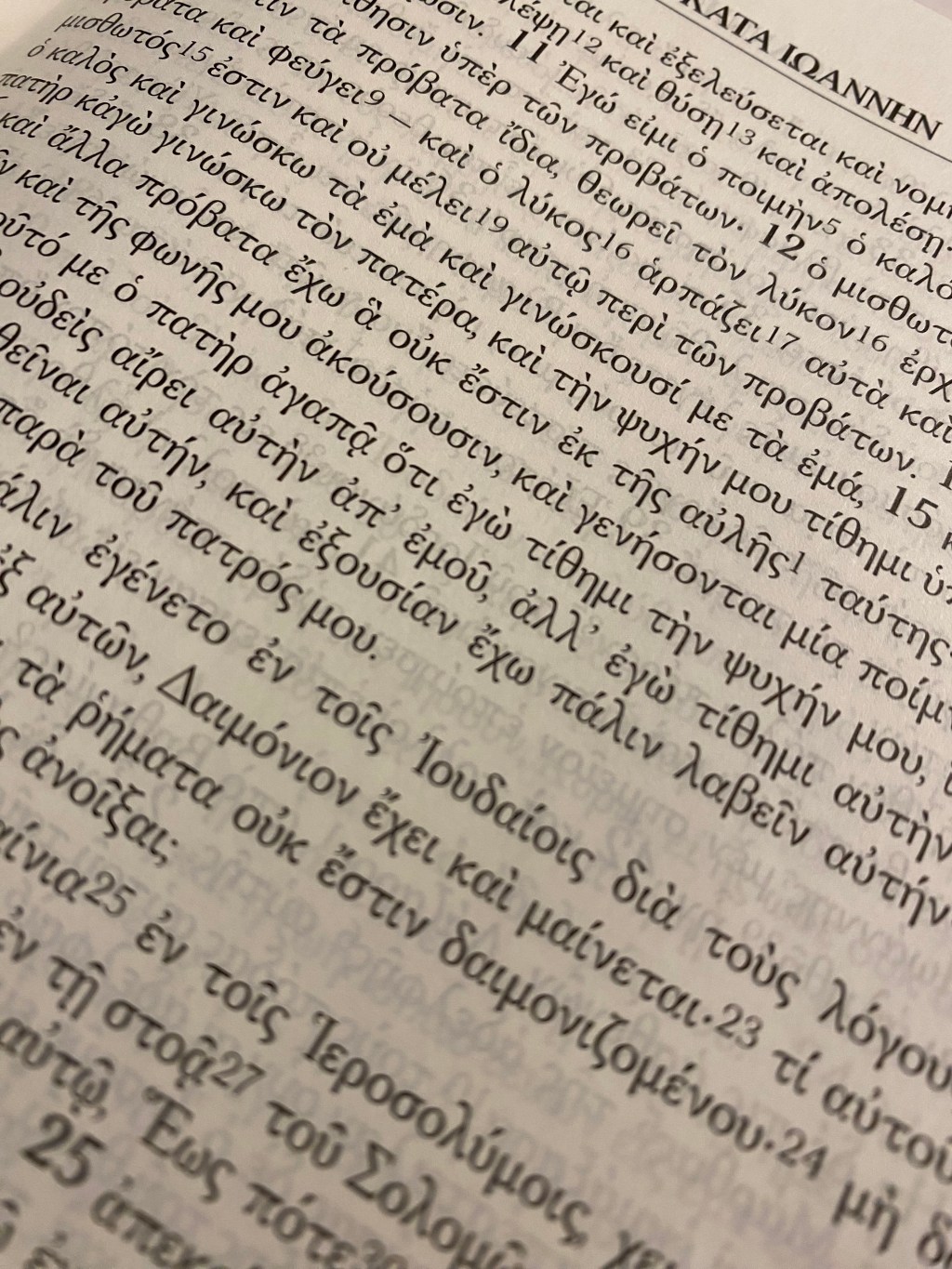
Beginning language work has little payoff in the beginning. It took my brain weeks of practice to finally read the fancy little ρ’s with an R sound. It was a struggle to remember all the tenses, case endings, and vocabulary. More than once I felt like it was truly “all Greek to me.” During an all-day Saturday class, I was struggling to understand the morphological changes and frustrated that it felt like I was never going to get it. I switched out a load of laundry during a break and began to cry. Why was I doing this? My family needed clean clothes, not Greek syntax. However, slowly but surely, the weeks of practice allowed me to take my Greek New Testament to church and follow along with the readings. I cried tears of joy when I realized I could understand my favorite verses in the original language. The work was finally paying off as I learned the principles of interpretation and took an exegesis class of James where I translated the whole book.
While I don’t aspire to be on a translation committee, having knowledge of Greek helps me read commentaries with a more careful eye. It enables me to notice when a commentator skips over a difficult reading in favor of a simplistic solution. I can look at the text and see how translation decisions were made and what alternatives are viable. Because the work of translation has been a male-dominated field for thousands of years, it’s no wonder that many of our English texts reflect a male-centric perspective.
My love for God’s word and desire to read it without the filters of other people’s interpretations led me to the work of language learning. Without training in the languages, women must rely on others and may default to whatever translation is preferred in the pew. If we want next generation to be empowered to read God’s word faithfully and accurately, it’s going to take more women committing themselves to studying the Biblical languages. Now, as a teaching assistant, I am training the next class of Greek students. After I teach, I switch into Hebrew learning mode and struggle through weak verbs and wonder anew if my decision to take Hebrew will benefit anyone. Then I remember all the women before me who were not allowed or encouraged to study these languages. My work is part of the labor needed to undo the years that women’s voices were not part of the translation conversation. What a privilege it is to read God’s word in the languages he chose to impart it in.
 Lark TheoSis
Leave a comment