This review was originally published in the March 2026 issue of The Journal of The Evangelical Homiletics Society.
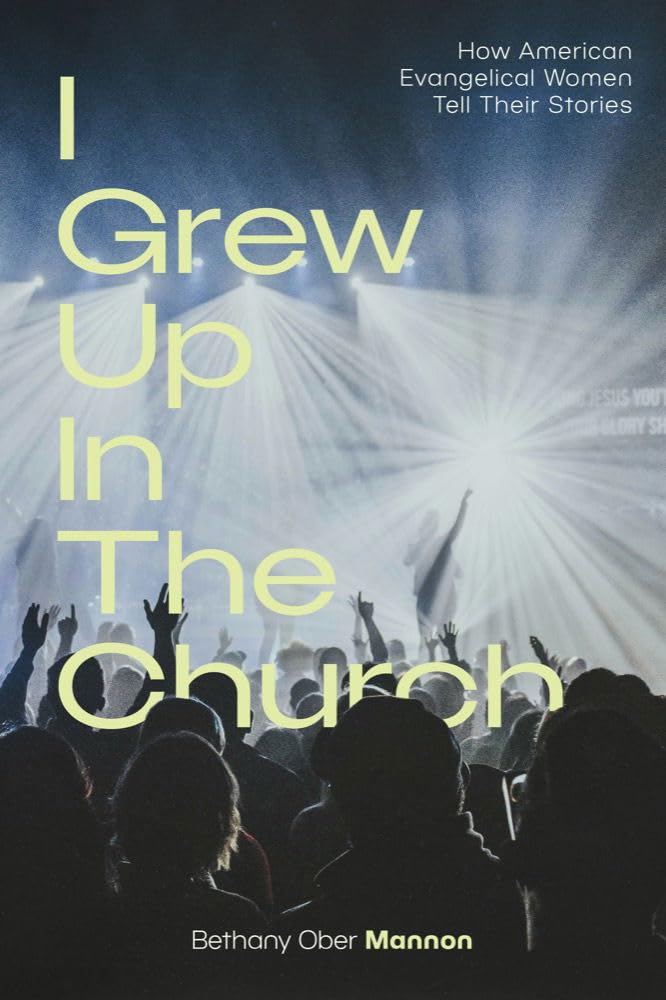
In 2016, Beth Moore tweeted about her experience of sexual assault. Reading her remarks sparked the curiosity of rhetorician Bethany Mannon concerning the way evangelical women were using personal narrative as a rhetorical strategy. Her position as Associate Professor and Director of Rhetoric and Writing Studies at Appalachian State University as well as her prior research on activism in women’s memoirs provided the necessary foundation for, I Grew Up in the Church: How American Evangelical Women Tell Their Stories. This book argues that women use personal narrative to critique the nature and impacts of mainstream evangelical rhetoric.
Even though women typically have limited access to the pulpit, they still find creative and strategic ways to shift evangelical discourse. Mannon limits her research to women writing in the decade between 2008-2018, considered part of the “Golden Age of Blogging.” During this period, evangelicalism began declining in numbers, but women were gaining massive followings online because they were effective writers and skilled at building an audience. Evangelical women writers took advantage of the lower threshold for entry that online platforms provided and used it to create spaces of connection for diverse communities. As technology continued to increase the access lay people had to the marketplace of evangelical ideas, women had more opportunities to speak and write with authority, whether online, in person, or in print.
Mannon begins by making a case for studying evangelicalism as a movement with a distinct rhetoric. “Defining evangelicalism as a theology, historical tradition, culture, coalition, or political identity looks at belief, heritage, consumer markets, self-identification and voting patterns – all certainly important. Yet studying the rhetoric of a movement turns to the commonplaces evangelicals employ when they argue over positions and ideas, or the practices with which they construct individual and collective identity and values” (35-36). After defining terms and providing an overview of the rhetorical history of evangelicalism in the United States, she notes the points when evangelicalism’s rhetorical distinctiveness took shape. She identifies eight commonplaces: individualism, conversion, fear, divine providence, biblical authority, white supremacy, certainty, and combat. These distinctives are predominantly communicated through the five practices of evangelism, preaching, biblical hermeneutics, apologetics, and testimony. She maintains that “the commonplaces and practices at the core of the evangelical movement are ripe for women to use and reform” (29). When evangelical rhetoric is analyzed, the focus is often on sermons and public oratory, but Mannon pays attention to the impact of testimony through personal narrative.
Chapters 2-5 examine four different groups of women. Chapter two uses Mark Driscoll as a case study to show how conservative women like Wendy Alsup, Hannah Anderson, Aimee Byrd, Trilla Newbell, and Karen Swallow Prior used rhetorical dexterity to create a generous orthodoxy that shifted away from using the tools of combat, fear, and certainty. Chapter three explores Rachel Held Evans’ storytelling as verbal hospitality and how her rhetorical education in the apologetics movement left her unequipped to respond to the everyday concerns of real people. Chapter 4 studies progressive women like Sarah Bessey, Austin Channing Brown, and Jen Hatmaker as a “resisterhood” of women addressing gender roles, hermeneutics, and social justice. Finally, Mannon surveys women’s rhetorical leadership in para-church ministries through an examination of strategies utilized by Latina American writers.
Mannon’s intended audience is rhetoricians, and the Religious Communication Association awarded it their 2025 Book of the Year. As such, it would not serve lay audiences interested in a concise summary of women writers or a historical overview. However, homileticians will benefit from its call to consider how personal narrative is an effective rhetorical strategy. Mannon predicts it will have continuing relevance, “As personal narrative becomes an especially popular form, it challenges sermons as the primary genre of contemporary evangelicalism and lessens its role as the organizing event of evangelical culture” (65). This claim may be too strong as sermons will continue to hold relevance, however developing skill in other practices may be an important counterbalance to mitigate the outsized weight that sermons often are forced to carry.
Overall, this book is a thoughtful consideration of evangelical rhetoric. Mannon makes an important argument that evangelical rhetoric has a tone, flavor, and distinct commonalities. Differing from a sociological or theological analysis of evangelicalism, this treatment attends to the approaches evangelicals tend to take in making effective arguments. By contrasting the ways women challenged those norms, it provides a clearer picture of possible ways forward.
See the original published review in Volume 26-1, pages 158-160 – JEHS-Archive – The Evangelical Homiletics Society


Leave a Reply