This review was originally published in the April 2025 edition of The Africanus Journal
Congratulations! You completed coursework in Biblical Greek. Now what?
Seminary professors often use the old adage, “If you don’t use it, you’ll lose it” in reference to language studies. Once course requirements are completed, it can be difficult for students to establish habits that keep them connected to the original languages.
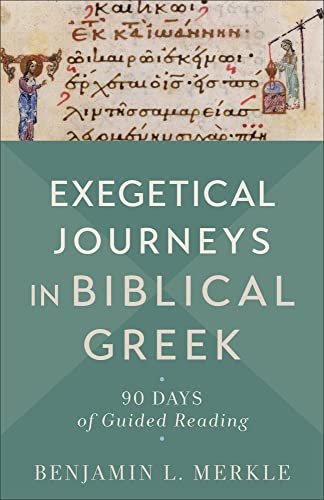
As an experienced professor and an author of one of the top introductory Greek Grammars (Beginning with New Testament Greek), Benjamin Merkle is well aware of the challenges that students face in language learning and maintenance. His previous book, Greek for Life: Strategies for Learning, Retaining, and Reviving New Testament Greek, gives compelling reasons to maintain language skills and offers suggestions on how to create reasonable rhythms. However, Merkle’s newest book in the field offers more than suggestions. It paves a pathway and provides a guide along the way.
After a short introduction, the book offers 90 daily readings to guide the reader through a 10–15-minute walk through the Greek text. The carefully crafted exercises are rooted in scripture, and each day focuses on just one or two verses. After reading the verse(s) aloud, the reader parses the verbs, identifies the nouns, and writes out a translation. An answer key is included so readers can check their work and learn from mistakes. The author also includes some syntactical notes and a short paragraph of commentary. Just as a student trained in art approaches a painting with a different appreciation than a general museum patron, a student trained in Greek has unique tools to aid their devotional reflection on the text. This book acts as a teacher standing with the student and reminding them of all they have learned, offering up a text so they can practice their Greek training. After five days the reader has covered a complete literary unit and moves on to a new selection of text. The selected readings include every New Testament author and a variety of literary genres.
Divided into three, 30-day “Journeys” (Easy, Intermediate, Difficult), this book is a perfect companion for a student in between semesters or former students looking to regain their proficiency. While there are plenty of websites and myriads of tools available to those who want to continue in their studies, the sheer number of resources itself can be paralyzing. Students can feel overwhelmed by the options they face in creating post-course habits. Merkle removes some of the hurdles by creating an easy-to-follow pathway to developing consistent post-course interaction with the Greek text.
The first 30-day journey would be ideal for use between semesters of Greek 1 and 2 to combat the attrition that often thwarts students early in their second semester. Or all three journeys could be completed over the summer to keep the language fresh for exegesis work in the fall. Although printed as a traditional paperback book, its function is intended as a workbook to write in. Hence, the relatively small size makes it suitable for travel, but the traditional paperback binding makes writing in the pages slightly cumbersome.
Professors can leverage this as a tool to keep students accountable in between semester breaks by assigning each of the three journeys at the close of three corresponding semesters in Greek, either as an optional assignment or as extra credit. Ideally this would be included in a resource list for purchase during the honeymoon phase of Greek 1 and become a lifeline to keep a student’s motivation rolling at the end of each semester. Alternatively, academic advisors could recommend this to students who have to take a pause in their Greek coursework or those considering returning after an extended break.
This book would also make a perfect gift for a graduating student, many of whom could benefit from a simple pathway that helps them reap the benefit of the investment of time and money they have already spent in their language studies. Although each daily lesson is short, it is not necessarily the depth but the consistency that is key. Developing a daily habit of interaction with the text becomes an on ramp to a lifetime of journeys through the original languages.
See the original published review in Volume 17-1, pages 52-53 – Africanus-Journal-Vol.17-No.1-April-2025.pdf


Leave a Reply