This review was originally published in the July 2026 issue of The Journal of The Evangelical Homiletics Society.
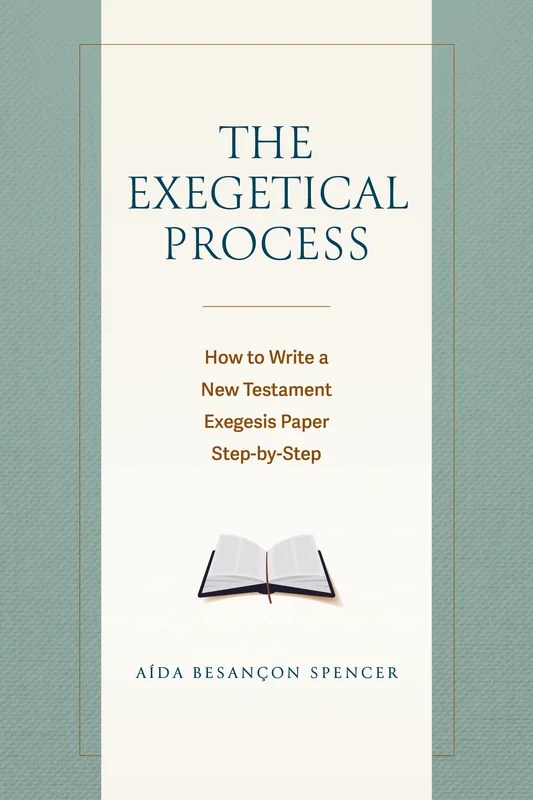
For decades, Aída Besançon Spencer, Senior Professor of New Testament at Gordon-Conwell Theological Seminary, has trained students how to write exegesis papers. With the publication of The Exegetical Process: How to Write a New Testament Exegesis Paper Step-By-Step, her expertise will continue to benefit countless students in the future. As a Hispanic woman from the Dominican Republic, she brings a distinctive voice and fresh insights and perspectives to exegetical study. Almost 50 years of teaching has honed her diligent scholarship, and her pastoral experience lends itself to rich homiletical application in this finely tuned work.
Compiling all aspects of exegetical study from beginning to end in one comprehensive guide, it echoes and expands on the legacy of New Testament Exegesis: A Handbook for Students and Pastors by Gordon Fee. Both Fee and Spencer were professors at Gordon-Conwell in the 1980’s and share a strong evangelical commitment to the authority of scripture. She states, “When we really believe the Bible is authoritative, we interpret it exegetically and we also obey its message. When we teach and learn methods for interpreting the Bible, we are doing what we can to understand God’s revelation, to obtain God’s meaning for a text, rather than simply giving a text the meaning we want it to have or think it should have” (66).
Recently in the field of biblical studies, there has been more attention given to Greco-Roman backgrounds in exegesis. While this is likely a well-intended move to correct past oversights, Spencer emphasizes that one must start with scripture itself. The “Priority of Context” pyramid (19) provides a visual aid to exemplify the various forms of contextual information. She reminds the reader that each does not carry equal weight in determining a passage’s meaning. With that established, Spencer instructs the reader on how to complete a thorough historical context survey to answer the questions of “from whom”, “to whom”, “when”, “from where”, and “why” a book or letter was written. With that context in hand, the exegete can create a thematic summary and outline the book/letter (Chapter 1). Several technical chapters follow on how to choose a text (Chapter 3), textual criticism (Chapter 4), grammatical translation and sentence flow (Chapter 4), word studies (Chapter 5), and stylistic analysis (Chapter 6). After full consideration of the authorial context, combined with in depth analysis of the text, one is finally prepared to explore extra-biblical Jewish and Greco-Roman resources (Chapter 7).
A theme throughout the book is the importance of doing one’s own work of exegesis before consulting commentaries so that a student builds confidence as a faithful exegete rather than simply repeating what is already in the guild. Yet, many also learn by reading others’ work. To aid in both ways, a sample exegesis paper on Philemon is included as a practical guide to model all the steps in the book (Chapter 8). The final chapter covers how to interact responsibly with commentaries (Chapter 10).
Chapter 9 is of particular interest to homileticians as it covers how to move from exegesis to application, including tips for developing a sermon outline from exegetical work. However, Dr. Spencer’s homiletical insights are not confined to that chapter alone but are woven throughout. She displays a pastoral heart in instances like reminding readers to consider their hearers when choosing a text for study.
The natural audience for this book is a student who has recently completed basic Greek language study and is moving into interpretation and exegesis. Earlier versions of the text were printed at Gordon-Conwell as a workbook and used by students in interpretation and exegesis classes. Thus, some of the sample formatting (“student box number”) may not be applicable in other settings. New professors will welcome the sample grading rubrics, but experienced professors may find them unhelpful if they already have a system developed.
However, even those without language training can utilize the techniques in the interpretation process because there are notes for which steps to omit. Preachers will appreciate guided instruction that can help improve their preaching through stronger exegetical skills. Professors seeking to diversify their syllabi without sacrificing their evangelical convictions will find this text a welcome addition to their course content.


Leave a Reply